Introducion
As a small businessman, bringing more customers online probably will be one of your objectives. Without letting your potential customers know about your business, they can’t purchase your products or services.
That is the area in which digital marketing comes into play, two of the best marketing strategies online are Pay-per-Click advertising and Search Engine Optimization. These two methods boost businesses in search engines such as Google, but in two different ways.
Owning a small business, you’re often in a position to choose between SEO and PPC or opt for a blend of the two. It depends on your business objectives, competition, and budget, as well as how quickly you need to see results.
In this guide, you will understand the difference between SEO and PPC, the pros and cons of each, examples, and how to decide which one is suitable for your business. Today, I will explain SEO vs PPC: Which is preferable for a small business?
What Is SEO?
The overall activity or starting point of making your website appear higher in Google’s natural search results is search engine optimization. SEO requires optimization of your page content, speeding up the page, optimization of its keywords, optimization of quality backlinks, and optimization of user experience.
If all these points are optimized properly, your site will be considered a valuable site by search engines. Be placed on top of other sites for users doing relevant search queries.
If you have a Lahore bakery and your website is on the first page for best bakery in Lahore, people who search for this term can easily locate your business without having to click on intrusive advertisements. While SEO can be time-consuming, it can yield long-term benefits, the traffic can continue to flow while you don’t pay for every click.
What Is PPC?
Pay-Per-Click (PPC) is an advertising method in which enterprises pay every time they achieve a click of their ad is clicked, Google Ads is the most popular PPC platform.
Companies select keywords, develop Pay-Per-Click ads, and compete with other companies. If users search for these keywords, then Google may show the advertisements that are above the organic results.
For example, when someone searches for emergency plumber near me, PPC ads place your business at the top of the search results almost instantly.
PPC enables organisations to get instant traffic when they run a campaign, but advertising is so thoroughly funded that traffic stops only as the money runs out.
Benefits of SEO for Small Businesses
SEO helps small businesses reach more potential customers without relying only on paid advertising. It improves search engine rankings, increases organic traffic, and builds brand credibility.
A well-optimized website also provides a better user experience, leading to higher engagement and more conversions. Over time, SEO delivers long-term results and supports sustainable business growth.
Long-Term Growth
A high-ranking article can draw traffic for months or more, SEO supports long-term business growth by helping your website attract consistent organic traffic over time. According to HubSpot, organic search is one of the largest sources of website traffic, making SEO a valuable long-term investment for businesses.
Unlike paid advertising, SEO continues to deliver results even after your optimization efforts. A strong SEO strategy builds online visibility, increases brand credibility, and creates a steady flow of potential customers for sustainable growth.
Higher Trust
Paid ads aren’t viewed as credible as organic search results, as many users believe Google will recommend the most useful websites. Higher Trust: SEO helps build trust by improving your website’s visibility in organic search results.
Users often consider websites that rank naturally to be more credible than paid ads. High-quality content, a secure website, and a positive user experience further strengthen customer confidence in your business.
Improved ROI!
While it takes some work to do, search engine optimisation can pay off more over time as businesses don’t have to pay for customers who find them in search engines.
SEO Brand Authority
Being in the top position on Google’s first page lends credibility. Clients tend to think that the higher ranked, the more reliable. If you need a short SEO-optimized paragraph for the heading Brand Authority, you can use this.
Strong SEO helps build this authority by creating high-quality content, earning backlinks from trusted websites, and improving online visibility. When customers repeatedly see your brand in search results.
They are more likely to trust your products or services, over time, higher brand authority leads to better rankings, increased website traffic, and stronger customer loyalty.
Sustainable Traffic
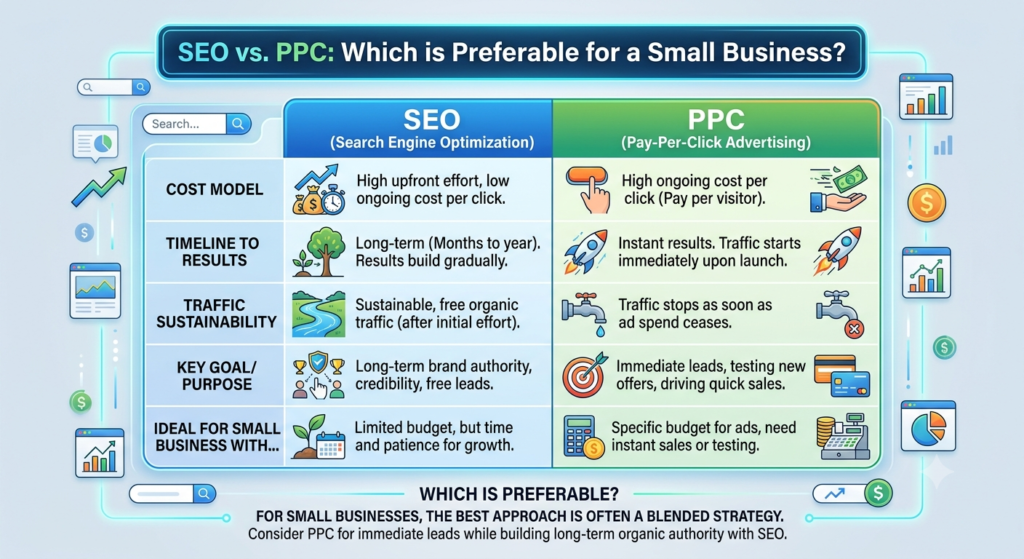
SEO is different from PPC campaigs, cause when you start a short-term campaign, you don’t see the traffic amount drop quickly. SEO is not like PPC campaigns in which the traffic volume would drop instantly if the campaign is not being executed for a few days.
Benefits of PPC for Small Businesses
PPC helps small businesses attract targeted customers quickly by placing ads at the top of search engine results. It delivers instant visibility, drives qualified traffic, and allows you to control your advertising budget. PPC also provides measurable results, making it easy to track performance and optimize campaigns for better conversions.
Instant Visibility
PPC provides instant visibility by placing your ads at the top of search engine results as soon as your campaign goes live. Unlike SEO, which takes time to improve rankings, PPC can drive targeted traffic immediately.
This makes it an excellent option for small businesses that want quick results, promote new products, or run limited-time offers. According to Google Ads, businesses can start showing ads in search results shortly after launching a properly configured campaign, allowing them to reach potential customers quickly.
Highly Targeted Advertising
Users can be targeted by location, device, language, interests, demographic, and even according to the time or day. PPC allows businesses to target the right audience with precision. You can reach potential customers based on keywords, location, age, interests, device, and even the time of day.
This targeted approach helps attract qualified leads, improves conversion rates, and ensures your advertising budget is spent on users who are most likely to become customers.
Fast Lead Generation
PPC is an effective way to generate leads quickly, once your ads are live, potential customers can find your business immediately and take action by filling out a form or purchasing a product. This fast response makes PPC ideal for businesses that need immediate inquiries, sales, or customer growth.
Easy Performance Tracking
Reports from the platform, such as Google Ads, ds will provide you with details of clicks, impressions, conversions, etc., and ROI. PPC campaigns provide detailed performance data, making it easy to measure results.
You can track clicks, impressions, conversions, cost per click, and return on investment in real time. These insights help you optimize your campaigns, improve performance, and make informed marketing decisions.
Budget Control
Budget Control: PPC gives small businesses complete control over their advertising budget. You can set a daily or monthly spending limit and adjust it at any time.
This flexibility helps you manage costs while reaching your target audience. With proper campaign optimization, you can maximize your return on investment without overspending.
PPC platforms allow advertisers to set daily and monthly budgets, helping small businesses control advertising costs while optimizing campaign performance.
SEO vs PPC Comparison table
Feature SEO PPC Cost Organic traffic, no cost per click Pay for every click Results Takes 3–6 months Immediate traffic Long-Term Value High and sustainable Ends when ads stop Trust Higher user trust Marked as sponsored ads Best For Long-term business growth Fast sales and promotions Click-Through Rate Usually higher for top organic results Depends on ad quality and budget Maintenance Regular content and SEO updates Continuous budget management ROI Strong over the long term Strong for short-term campaigns
Real-life example for SEO vs PPC
AquaSwitch
AquaSwitch, a UK-based business, initially relied on Google Ads. However, rising advertising costs made PPC less profitable. The company shifted its focus to SEO by creating high-quality content, improving website speed, and targeting long-tail keywords. Within months, it ranked #1 for several high-intent keywords and generated 162 organic leads in a single month, significantly reducing customer acquisition costs.
conclusion
The decision to go with SEO or PPC depends on your business goals, budget,t and timelines. SEO provides a great choice for long-term growth, credibility, ty and long-term organic traffic. PPC, on the other hand, can provide you with instant visibility and quicker outcomes, which makes it perfect for time-sensitive campaigns.
For the majority of the smbusinessesness, reserved marketing and internet marketing would have a great impact on great outcomes. Build a great SEO profile for ongoing success, with PPC to serve as a quick, ultimate generator of leads.
A balanced approach can help boost online presence, attract more customers, and even lead to better returns in the long haul. Combining SEO for long-term growth with PPC for immediate visibility creates a balanced digital marketing strategy for many small businesses.
FAQS
SEO focuses on improving organic search rankings over time, while PPC uses paid ads to generate immediate traffic.
SEO is better for long-term growth and sustainable traffic. PPC is ideal for businesses that need quick visibility and fast results.
Yes. Combining SEO and PPC can increase online visibility, attract more customers, and improve overall marketing performance.